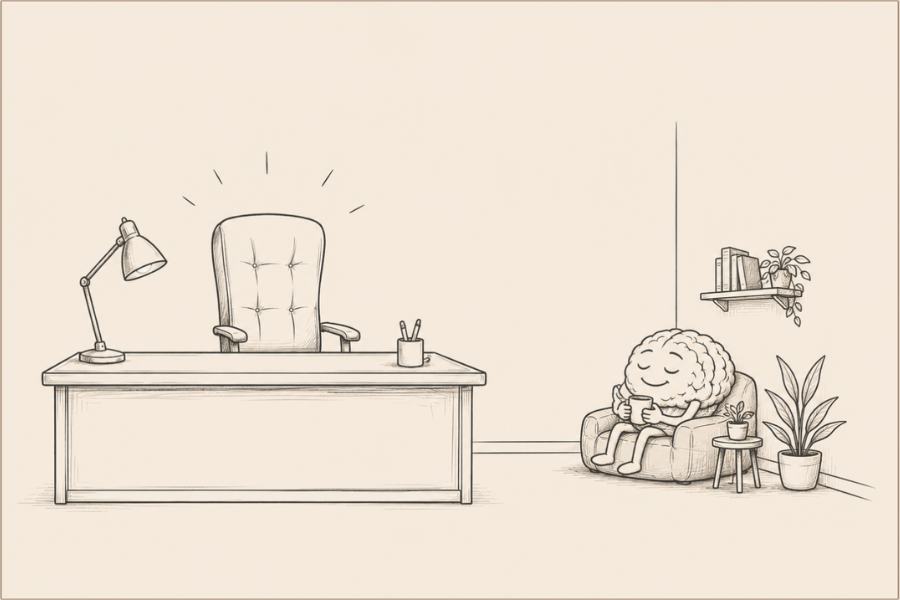
For most of our lives, the mind acts as the gatekeeper. Everything must pass through intellectual processing before we trust it. But when the mind dominates, we disconnect from embodied, emotional, and intuitive knowing. Demoting the mind means repositioning it as a tool, not the authority. When we consult the whole self (mind, body, heart, spirit), we stop getting in our own way and move from force to flow.
In the past, when someone showed me an image of a brain, a heart, and a gut and asked: "Which one do you operate from?" I would point to the brain without hesitation.
The mind is the processor. The analyzer. The place where we make sense of everything. How could we possibly know our hearts or understand our gut instincts without the mind interpreting them first?
For most of our lives, the mind has been the authority. The gatekeeper. The final say. And that makes sense. We live in a culture that prizes intellectual knowing above all else. Logic. Analysis. Proof. Understanding. The mind is what separates us from pure instinct or blind emotion. It's what allows us to think critically, solve problems, and make informed decisions.
The mind is essential. But it becomes a problem when the mind becomes the only way we know anything. When it dominates. When it overrides the body, dismisses intuition, and demands intellectual proof before we're allowed to trust what we feel.
This is what I mean by demoting the mind. We're not rejecting intellect. We're repositioning it. The mind is a tool, not the boss. When we mistake it for the authority, we disconnect from other essential ways of knowing: embodied knowing, emotional knowing, and intuitive or spiritual knowing.
Demoting the mind is how we stop getting in our own way.
What does it mean to demote the mind?
Demoting the mind means deprioritizing intellectual processing as the primary way of knowing. It means the mind is no longer the gatekeeper that everything must pass through before we're allowed to trust or know something to be true.
For most of us, the mind sits at the top of a hierarchy. We feel something in our body or we sense something intuitively or we experience an emotional truth. Then we wait for the mind to validate it. To explain it. To make it make sense.
If the mind can't explain it, we dismiss it. We override it. We tell ourselves it's not real, not rational, not trustworthy.
Demoting the mind reverses that order. The body speaks first. Intuition speaks first. The heart speaks first. The mind listens, interprets, and supports. It lets it be and doesn’t override.
This doesn't mean we abandon logic or critical thinking. It means we stop requiring intellectual proof before we trust what we know in our bodies, our hearts, and our spirit.
Why do we prioritize intellectual knowing?
We prioritize intellectual knowing because we've been taught that it's the most reliable form of truth. The mind can be trained. It can be sharpened. It can distinguish fact from fiction, reality from illusion.
The body, on the other hand, feels unreliable. It gets tired. It reacts. It sends signals we don't always understand. Emotions cloud judgment. Intuition can't be measured. Spiritual knowing sounds like woo to anyone who values science and proof.
So we learn to trust the mind above all else. We become skilled at thinking our way through problems, analyzing situations, and seeking the why before we allow ourselves to feel, act, or trust.
This becomes particularly true for those of us like me who value research, science, and concrete evidence. If we grew up questioning dogma or rejecting belief systems that asked us to accept things without proof, the mind becomes our anchor. It's what protects us from blindly following something we don't understand.
The mind becomes the authority because it earned our trust through logic.
How does mind-dominance create self-abandonment?
Self-abandonment is the pattern of overriding our own needs, feelings, and truth in order to stay safe, connected, or accepted. Mind-dominance is one of the primary ways we abandon ourselves.
Here's how it works:
The body sends a signal. "I don't want to go to this event." The mind immediately steps in. "But you committed. It would be rude not to show up. You don't have a good enough reason. People will think you're flaky."
The mind overrides the body. We go to the event. We abandon the body's knowing in favor of the mind's reasoning.
Intuition says "this relationship doesn't feel right." The mind counters. "But they check all the boxes. On paper, this makes sense. You're just being emotional. You're overthinking it."
The mind overrides intuition. We stay. We abandon our inner knowing in favor of the mind's logic.
This pattern repeats across our lives. The body knows. The heart knows. Intuition knows. And the mind talks us out of it.
Every time the mind overrides what the body, heart, or spirit is communicating, we fracture. We create an internal split between the part of us that knows the truth and the part of us that rationalizes it away.
Over time, we lose contact with embodied knowing entirely. We stop consulting the body. We stop trusting intuition. We rely exclusively on the mind to tell us what's true. And the mind, divorced from the body and spirit, makes decisions that feel logical but leave us disconnected, exhausted, or stuck.
That self-abandonment—that internal fracture we create—doesn't just disappear. It lives somewhere. The body holds what the mind dismisses. The suppression manifests. Sometimes as chronic tension. Sometimes as unexplained pain. Sometimes as illness or exhaustion that doesn't match our circumstances. The dis-ease we create internally will express itself externally. The body always keeps the score.
What does it look like to be "in your own way"?
Being in your own way means the mind is blocking your ability to flow, to be, to trust what you know without needing to understand it first.
It shows up as:
Overthinking decisions until we're paralyzed. The mind spins through every possible outcome, every potential risk, every reason something might go wrong. We can't move forward because the mind won't let us act until we have certainty. And certainty never comes.
Forcing outcomes instead of flowing. We try to control everything through mental effort. We plan, strategize, analyze. We push. We manage. We override what wants to unfold naturally because the mind insists on directing it.
Needing to understand before we're allowed to feel. Something happens. The body reacts. The heart feels. And the mind immediately jumps in: "Why do I feel this way? What does this mean? Where did this come from?" We can't just be with the feeling. We need the mind to explain it first.
Dismissing intuition or spiritual knowing because it doesn't make logical sense. We sense something. We know something. But the mind demands proof. "How do you know that? What evidence do you have? That's not rational." So we ignore it. We override it. We abandon it.
This is what it means to be in your own way. The mind, trying to protect us through control and understanding, actually keeps us stuck. It blocks the flow of life itself.
What are embodied, emotional, and intuitive ways of knowing?
Embodied knowing is what the body communicates through sensation, tension, ease, or discomfort. It's the gut feeling that says "yes" or "no" before the mind has a reason. It's the tightness in the chest when something feels wrong. It's the relaxation in the shoulders when something feels right. Embodied knowing doesn't need explanation. It just is.
Emotional knowing is what the heart communicates through feeling. Grief. Joy. Anger. Love. Fear. Emotions carry information. They tell us what matters. What's been violated. What needs attention. When we dismiss emotions as irrational or try to think our way out of them, we lose access to what they're trying to show us.
Intuitive or spiritual knowing is what comes through in ways the mind can't explain. It's the hit. The knowing. The sense of something beyond logic. It includes beliefs, practices, and laws beyond intellect that can't be proven but are deeply felt or known. Manifestation. Synchronicity. Energy. Interconnectedness. The body as a vessel for something larger. This knowing doesn't require intellectual validation. It operates on a different frequency entirely.
When we demote the mind, we're making space for these other ways of knowing to inform and enrich us. The mind can still interpret, support, and execute. It just doesn't override or demand understanding before we're allowed to trust.
How does this relate to science vs. spirituality?
Many of us resist demoting the mind because we value science, research, and concrete proof. We're drawn to logic. We left behind belief systems that asked us to accept things without question. The mind is what protects us from blind faith.
Here's what's important: when we demote the mind it doesn’t mean we are rejecting science or intellectual rigor. It means recognizing that the mind is one way of knowing, not the only way of knowing.
Science operates within the realm of what can be measured, tested, and replicated. That's valuable. That's necessary. There are also entire dimensions of human experience that can't be captured by those methods. And actually, if you think about it, there are even reputable fields of science that are based on the unseen: quantum physics, neuroscience, psychology. The unseen has always been part of rigorous inquiry.
The body's knowing / intuitive hits / spiritual experiences / energy—these operate beyond the intellect. They can't be proven in a lab. That doesn't make them less real. It makes them a different kind of real.
The false binary is this: either we trust science and reject the "woo," or we embrace spirituality and abandon logic. Demoting the mind dissolves that binary. We can value research and also trust what the body knows. We can love science and also believe in things that can't be proven. The mind doesn't need to validate the spiritual for the spiritual to be true.
This is especially important for those of us who do practices like yoga, meditation, breathwork, plant medicine, or energy healing and simultaneously feel resistance to calling ourselves "spiritual" because we associate spirituality with dogma or blind belief.
Spirituality, redefined, can be this: beliefs, practices, and laws beyond intellect that cannot be proven and are beyond the mind. All of it combined is like an inner philosophy. It's rooted in lived experience, not external authority. And it doesn't require the mind's approval to be valid.
What does it look like to consult the body and spirit first?
Consulting the body and spirit first means we pause before the mind takes over.
A decision comes up. Before we analyze it, we check in with the body. Does this feel like a yes or a no? Where do I feel that in my body? What is my gut telling me?
We let the body inform first. Then the mind can interpret and support.
An emotion arises. Before we explain it away or rationalize it, we let it be there. We ask: what is this feeling trying to tell me? What does my heart need right now? And we are ok sitting there waiting for an answer or with no answer. We let the emotion inform first. Then the mind can help us respond if there is a way to interpret it.
An intuitive hit comes through. Before we dismiss it as irrational, we notice it. We honor it. We ask: what is this knowing pointing me toward?
We let intuition inform first. Then the mind can help us act on it.
This doesn't mean the mind is silent. It means the mind comes second. It listens. It translates. It executes. But it doesn't override or seek to understand.
This is how we move from force to flow. From being in our own way to being in alignment. From intellectual control to embodied trust.
How can I practice?
Notice when the mind is overriding. When you feel something in your body and the mind immediately jumps in with reasons why that feeling isn't valid. When intuition says something and the mind demands proof. When you're stuck in analysis paralysis, spinning on a decision the body already knows the answer to.
That's the cue. The mind is trying to override.
Pause. Ask: what is my body saying right now? What does my heart know? What does my intuition sense?
Let those voices speak first. Let them inform. Trust whatever arises. Listen. And then—only then—let the mind support.
This takes practice. The mind is used to being in charge. It will resist. It will demand explanations. It will try to reclaim authority.
The practice is gentle but consistent: body first. Heart first. Spirit first. Mind second.
Over time, this becomes the new default. And when it does, we stop getting in our own way. We stop forcing. We flow. We trust. We move from self-abandonment to self-loyalty—not just in action, but in how we know what's true.
Demoting the mind is ongoing work. It's the practice of consulting the body, heart, and spirit first—before the mind interprets, analyzes, or overrides. This shift moves us from intellectual control to embodied trust, from force to flow.
Frequently asked questions
How do I know if I'm over-relying on my mind? Signs of mind-dominance include: overthinking decisions to the point of paralysis, needing to understand why you feel something before you allow yourself to feel it, dismissing intuition or body signals because they don't make logical sense, forcing outcomes instead of allowing things to unfold, and feeling stuck despite doing all the "right" things mentally. If you find yourself saying "I know what I should do, but I can't seem to do it," or “I know something is in my way, I just don’t know what it is,” that's often the mind overriding the body.
Can I trust my body if I've been disconnected from it for years? Yes. The body never stops communicating. Even if we've been ignoring it for years, it's still sending signals. Reconnection starts with noticing. What does my body feel like right now? Where is there tension, ease, discomfort, or relaxation? We don't need to interpret it right away. We just need to notice. We listen inward, not upward. Over time, that noticing rebuilds the relationship. The body learns we're listening again and the signals become clearer.
How do I demote the mind without losing my ability to think critically? Critical thinking and intellectual rigor remain intact. Demoting the mind simply means we're no longer using the mind to override what the body, heart, and spirit communicate. Think of it this way: the mind is a brilliant consultant. It analyzes data, considers options, identifies risks. But it's not the CEO. The body and spirit are. The mind informs decisions. It doesn't make them alone. This actually strengthens decision-making because we're integrating multiple forms of intelligence instead of relying on one.
What if I don't consider myself a spiritual person? This question resonates with me. I didn’t consider myself spiritual. What I learned is that spirituality doesn't have to mean what religion taught us. It can simply mean: beliefs and ways of knowing beyond intellect that can't be proven or seen but are deeply felt. If you've ever had a gut feeling that turned out to be right, if you've ever sensed something before it happened, if you've ever felt connected to something larger than yourself—that is a form of spiritual knowing. It doesn't require a label. It just is.