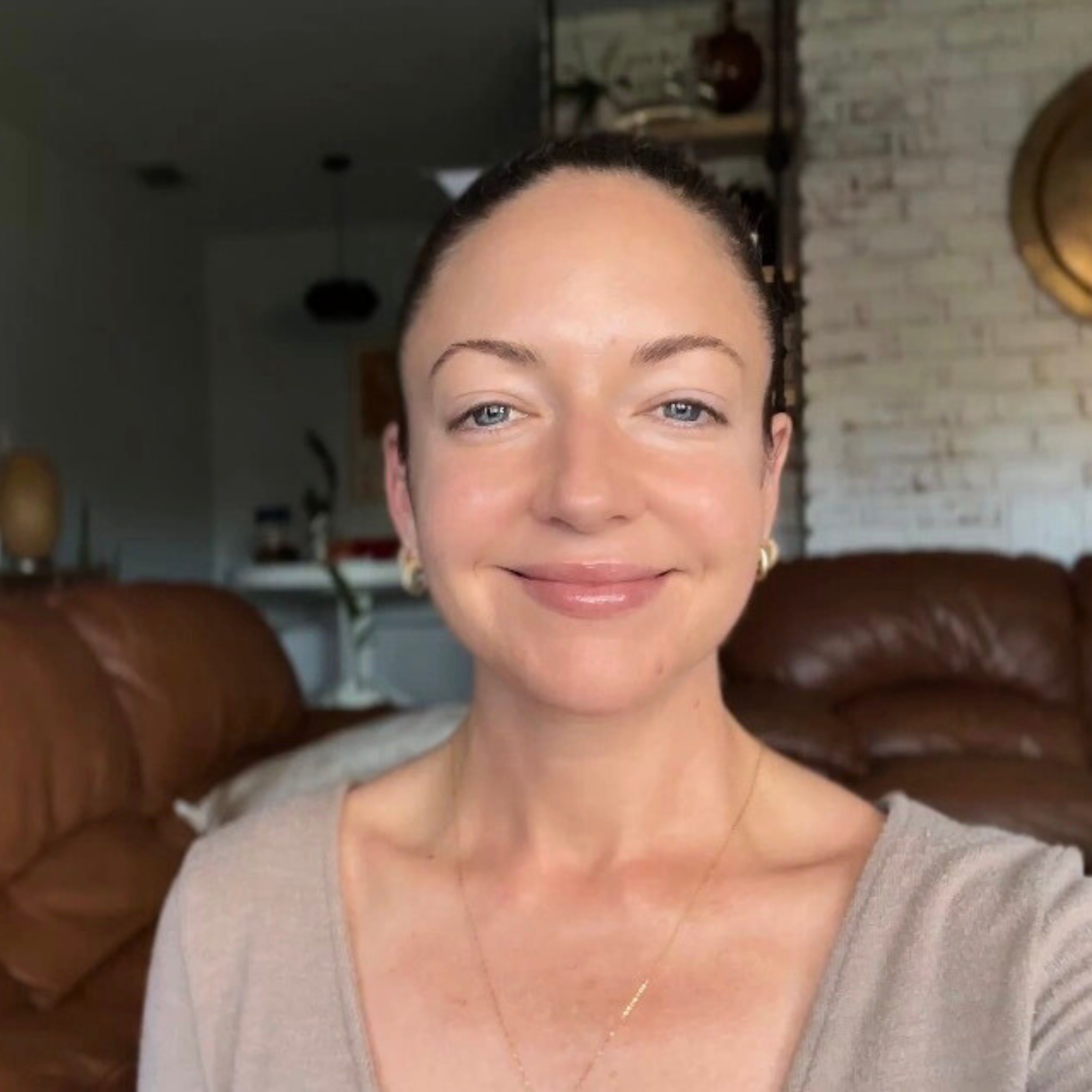
I'm working on improving my posture. It's something I've done since high school—hunched over a desk, curled into myself, taking up less space. At 40, I'm realizing how automatic it is.
What made it stand out was paying attention recording videos and noticing my shoulders rounding inward as I spoke. I only catch myself hunching at the end of my recordings, right when I'm about to close. It happens without me knowing it.
As I dug deeper into this pattern, I learned something that changed how we understand self-abandonment: our bodies aren't just expressing our beliefs. They're actively performing them.
The connection between posture and self-abandonment
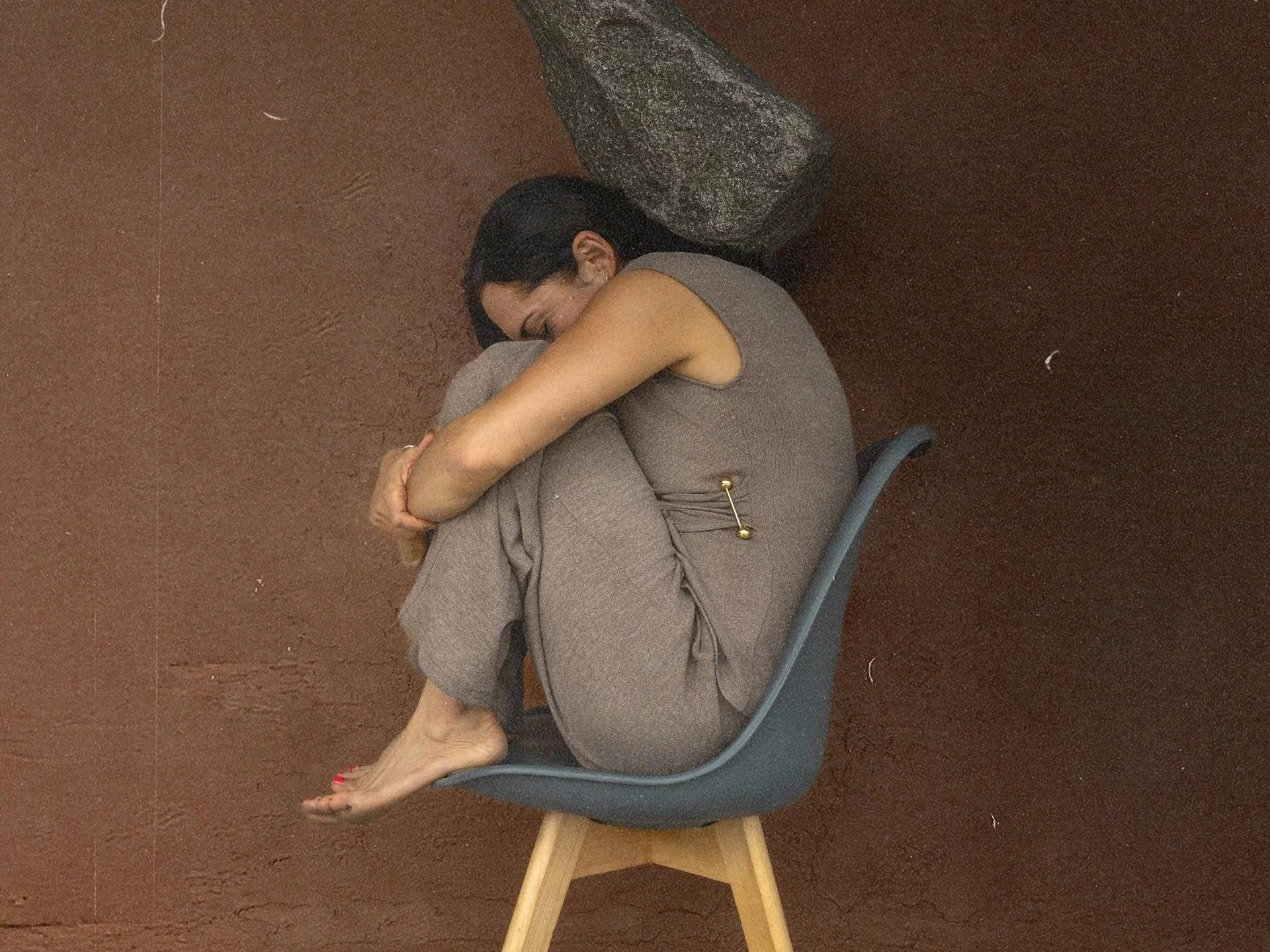
Self-abandonment doesn't announce itself loudly. It settles in quietly, first as a belief that we're not safe to be ourselves, then as a habit of adapting. Over time, that habit becomes embodied. It lives in our shoulders, our breath, our hands.
This is where embodied cognition comes in—the idea that our bodies and minds aren't separate systems. They're interconnected. Our emotions, beliefs, and psychological states directly shape our physical posture. And the reverse is also true: our physical posture influences our emotional and psychological state.
When we've learned early that our truth isn't welcome, we literally make ourselves smaller. We hunch. We soften our voice. Our hands move in smaller gestures. We're not doing this consciously. The body is simply translating an internal belief into physical form.
The science of hunching
Research on embodied cognition shows that when we hold closed, tight postures—hunching, slouching, closing in—we experience shifts in our emotional state and energy levels. Research conducted with 15 participants found that closed postures were associated with lower mood and less emotional energy, whereas upright postures were associated with increased feelings of power and confidence. More specifically, when we adopt a closed, tight posture, we become less aware of what our body is telling us.
This matters because our body is constantly sending signals: what feels true, what aligns with us, where our boundaries are. These signals come through what neuroscientists call interoceptive awareness—our ability to sense what's happening inside our body.
Interoceptive awareness is how we perceive sensations from inside our body. It includes the perception of signals related to our internal organs (like heartbeat, breathing, and digestion) and our autonomic nervous system activity related to emotions. It's essentially our internal sensory system—the way our body talks to us about what it needs, what feels right, and what doesn't. Much of this communication happens outside our conscious awareness, but when we pay attention, these internal signals become available to us.
When we hunch, we're literally dampening that internal signal. We're less able to feel what's true. We have less access to our intuition. Our own knowing becomes harder to hear.
The flip side is equally important: when we adopt an upright, open posture, we have better access to our internal signals. We become more aware of our body's wisdom. We can feel what's true more clearly.
We don’t want to force ourselves into confidence. We simply need to be aware that posture and internal knowing are linked. Our body position affects our ability to access our own truth.
The relapse: Why this is lifelong work
Here's what I’ve learned as I’ve worked on improving my posture: applying the lessons I’ve learned on good posture does not become automatic just because I decide it should.
I start my videos sitting up straight. I know that's the way. I've read the research. I understand the connection. But somewhere between the first seconds and the end of the minute, my shoulders cave in. My body reverts to what it knows best—the hunched position that says "I'm not fully here" and "I don't deserve all this space." I don’t think this in my mind, but my body still shows it.
This isn't a failure. It's the actual work.
Getting out of self-abandonment isn't like fixing a broken thing once and moving on. It's a practice. A constant noticing. A constant choosing. We relapse. We catch ourselves. We choose again. And because we learned self-abandonment early—often before we had language for it—our bodies remember it even when our minds have moved forward.
The body doesn't move as quickly as the mind sometimes does. It has its own timeline.
The embodied work
If self-abandonment lives in our bodies, then part of reclaiming ourselves lives there too.
This doesn't mean forcing ourselves to stand up straight or adopting power poses as a shortcut. It means becoming aware of what our body is doing and why. It means noticing the moments we hunch. It means understanding that hunching isn't a postural problem—it's a manifestation of a deeper belief about whether we're allowed to take up space.
The work involves:
Awareness. Noticing when we're making ourselves smaller. In our posture, our voice, our hand movements, our presence. Can we catch the moment our shoulders round in? Can we feel it in our body before our mind catches up? Noticing it is progress.
Curiosity, not judgment. What is our body telling us right now? What belief is this posture expressing? Am I safe to be here? Do I believe I deserve space?
Intentional practice. Standing upright for one video. Keeping our shoulders back for one conversation. Not because it's the "right" way, rather because we're experimenting with what it feels like to take up space.
Patience with relapse. We will hunch again. The automatic pattern will return. That's proof we've been practicing this old pattern for a very long time. We keep going.
Somatic practices that support this work—yoga, breathwork, any practice that reconnects us to our body—can accelerate our awareness. When we can feel our body, we can hear what it's saying.
What this reveals
The fact that we hunch. The fact that we find it hard to stand tall. The fact that it feels uncomfortable or even risky to take up space. These are messages to listen to.
Our body is showing us where self-abandonment lives. It's showing us the physical edge of the work. And it's showing us that reclaiming ourselves isn't just a mental exercise—it's a full-body practice.
At 40, I'm still catching myself hunching. I'm still practicing standing tall. I'm still choosing myself even when my body wants to contract back into what's familiar.
Here's what's different now: I understand what's happening. I'm not fighting my posture. I'm witnessing it. And in that witnessing, I'm learning to choose differently.
That's the real work. Not getting it right. Not being done with it. Staying present with it.
Sources:
Psych. (2023). "Understanding Embodied Effects of Posture: A Qualitative Study." MDPI, 5(2), 447-460. https://www.mdpi.com/2624-8611/5/2/30
Wikipedia. (2025). "Interoception." Retrieved from https://en.wikipedia.org/wiki/Interoception