Patterns of suppression don't disappear the moment we recognize them. They resurface—sometimes smaller, sometimes in unexpected forms. And each time they do, we have a choice. The work of ending self-override is cyclical, not linear. We recognize the old pattern, trace it back, choose a new way, and let our nervous system integrate the shift. Then life brings a similar moment, and we begin again at a deeper level.
Why do old patterns keep coming back?
I was in a coaching session recently about my upcoming book signing event. It should have felt like pure celebration. Instead, something old was lurking.
When I started thinking about the event, I noticed this feeling: I feel bad that people are going to come support me.
It didn't make logical sense. I know my work matters. I know my book helps people. I know this event is meaningful. And yet, there it was. That old feeling of guilt when people take time for me.
So I started tracing it back, like I do in all my work. Where does this come from?
I thought back to a dinner table scene in high school when I told my family I didn’t believe in the Catholic faith. It was my truth. My mom's reaction made it clear that this truth wasn't welcome in our home.
But worse than her reaction was what didn't happen: nobody created safety around what I'd just said.
When we go through difficult moments like this alone—without someone there to save us, to witness us, to say it's okay—it worsens the impact. Trauma researcher Bessel van der Kolk's work shows us why: we need that protection, that safety, that someone to create a bridge between us and what happened. Without it, the wound goes deeper.
So in that moment at the dinner table, without anyone there to make it safe, I learned something that would shape decades of my life: my truth is not ok. And nobody is going to make it safe.
From that point on, I learned to make myself smaller. Quieter. Less visible. If I wasn't so present, if I didn't take up too much space, maybe I wouldn't create that kind of discomfort again.
Decades later, here I was with a book about following what is true despite any doubt, still carrying that learned pattern. And it was showing up in an unexpected place: feeling bad when people wanted to celebrate me. Feeling guilty taking up their time and attention for something about me.
This is how self-abandonment works. It doesn't always announce itself. It shows up in everyday moments we wouldn’t think to question.
What is the cycle of pattern recognition and return?
The real breakthrough came when I named exactly what was happening: I don't like taking up space and time.
That phrase held it all. It was the old pattern, but it was also the bridge to the new. Because what I'm learning now is that taking up space and time isn't selfish or wrong or something to apologize for. It's my birthright.
So the bridge became clear: the same belief that kept me small in the old way is the exact belief I need to transform into my new way of thinking. Taking up space went from something to hide to something to claim.
After unpacking all of this and tracing it back to its roots, I asked myself: What do I want to feel instead?
The answer was simple but profound. As it relates to my book signing event:
Old: I feel bad that people are going to come support me.
New: I feel good that people are going to come support me.
A small shift. A powerful one. It aligns with everything I teach about self-trust and self-loyalty—choosing our truth even when the old pattern is louder.
So I wrote it down. I made it a note to myself for the book signing. I wrote: I feel good that people are going to come support me. This is who I am now.
When knowing isn't enough
Here's what I didn't expect to come through in the coaching call: knowing something and believing it aren't the same as the nervous system settling into it.
I can think my way into this new way. I can believe it. I can know it's true.
My nervous system though? It's still catching up.
This is the part nobody talks about. You can do all the inner work. You can trace your patterns back to their origin. You can identify the new way you want to be. You can write affirmations. You can speak them out loud every day. You can heal your heart out. This is all mental.
The body needs something different to feel safe. Research on nervous system stress responses shows that our patterns of self-protection are stored not just in thought but in the body. The nervous system learned the old way for a reason. It integrates the new way slowly, through repeated experiences of safety.
So I'm slowing my breath. Noticing my body bracing and softening it. Telling myself over and over: I am safe now. Tapping into the parasympathetic nervous system through breathwork. I'm learning to relax into a nervous system that believes what my mind already knows.
This is the next level of the work. Not just insight, but embodiment.
How does real change actually happen over time?
Here's what I know now about transformation: it's not a straight line upward. It's a return.
We recognize an old pattern. We see where it came from. We choose a new way. Our nervous system integrates the shift. And then life brings us a similar moment, and we recognize the old pattern again—sometimes smaller, sometimes in a different form.
This is the rhythm of real change.
Each time we recognize it and choose again, we're strengthening the new way. We're teaching our nervous system that yes, it's safe to take up space now. Yes, it's safe to be celebrated. Yes, it's safe to receive.
We return to ourselves. Again and again. Each return deepens the roots.
This is the lifelong work of ending self-abandonment. Not fixing it once and moving on, but recognizing when the old shows up and consciously choosing the new.
This is who I am now.
And when the old whispers again tomorrow, we'll recognize it and we'll choose again.
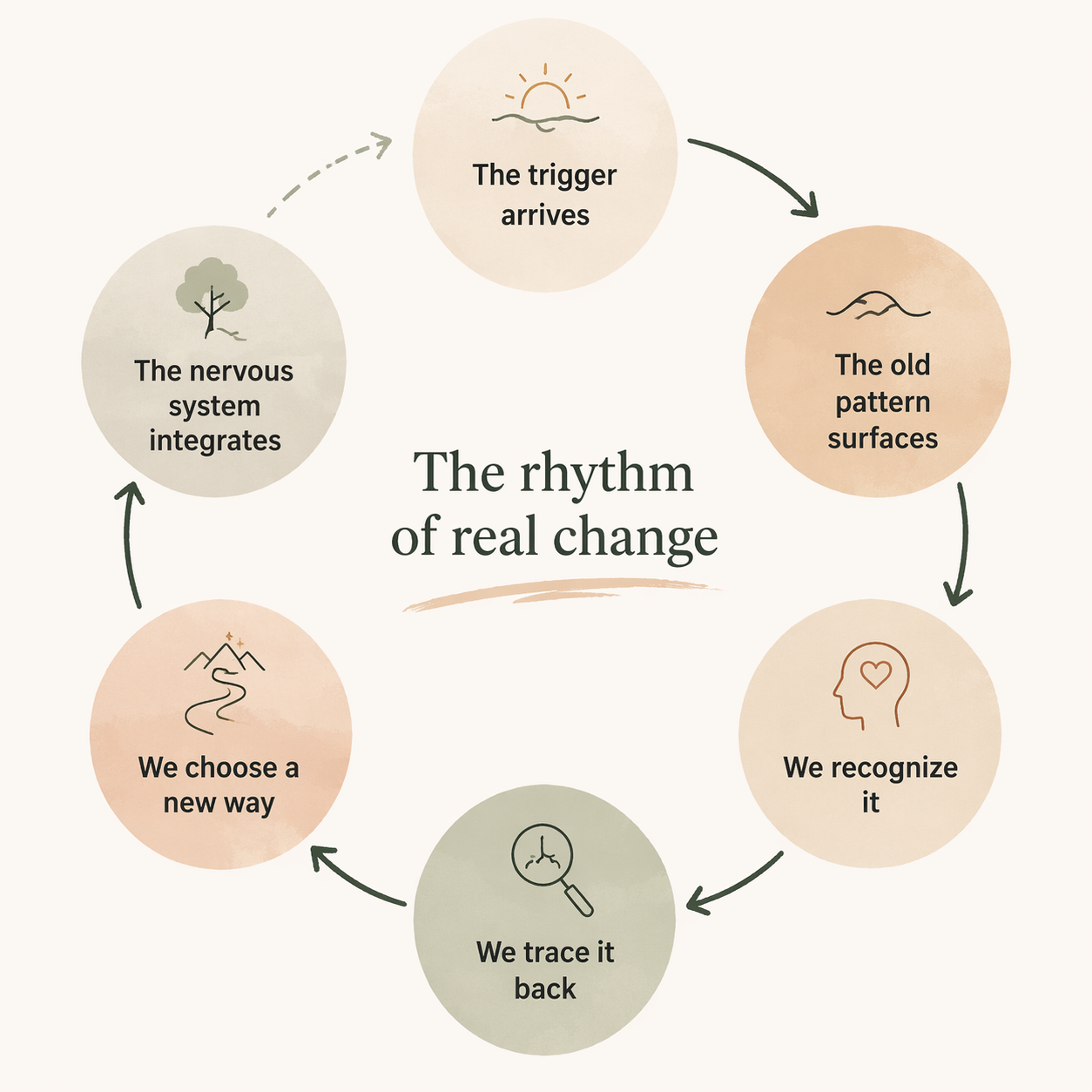
The work is not linear. Each return to ourselves deepens the roots.
Four ways to work with what's lingering
If you're noticing an old pattern that hasn't fully left (even though you know better) here's how to work with it:
1. Name it clearly
Not vaguely, not kindly. State it exactly as it feels: I feel bad when people celebrate me. I don't want to take up their time. I feel guilty when I receive. The specificity is where the power is.
2. Trace it back
Where did you first learn this? Not to blame your past, but to understand it. When did your truth become unsafe? When did you learn to play small? Understanding the origin removes the shame and makes space for compassion.
3. Identify the bridge
What connects the old pattern to the new way we're building? For me, it was taking up space. In the old way, it meant playing small. In the new way, it means worthy.
Find the bridge. Name it. That's where the shift happens.
4. Create a new affirmation
Not a generic one. One that speaks directly to what we're integrating. Something the nervous system can settle into over time. Write it. Say it. Let the body learn it. Return to it when the old pattern surfaces again.
We are safe now
The truth that wasn't safe at that dinner table is safe now.
Our truth has always been safe. It was just us trying to protect ourselves by making ourselves smaller.
Now we’re learning a new way. The way of taking up space. Of being celebrated. Of receiving without guilt. Of knowing that our presence matters.
This is self-loyalty.
Every time we choose it, even when the old way whispers, we’re teaching our nervous system something new: This is who I am now.
Let that settle in your body. Not just your mind, but your body.
Return to yourself when you need to. Again and again.
Frequently asked questions
Why do old patterns come back even after we've done the work? Old patterns resurface because they're stored in the nervous system, not just in thought. We can understand a pattern intellectually and still find it showing up in moments of stress, celebration, or vulnerability. That's the cycle of real change. Each return is an opportunity to choose differently, and each choice deepens the new way.
What does it mean to trace a pattern back? Tracing back means following the feeling to its origin to understand it. Most of our self-abandonment patterns began at a specific moment when we learned our needs, truth, or presence wasn't safe. Finding that moment removes shame and creates the compassion we need to actually shift.
How long does it take for the nervous system to integrate a new pattern? There is no fixed timeline. The nervous system integrates through repeated experiences of safety, not through insight alone. Breathwork, somatic practices, and consistent return to the new way all support that process. What matters most is continuing to recognize the old pattern and choose again. Each time, the roots of the new way grow deeper.