
Self-override isn't something we heal once and move on from. It moves in a cycle. A trigger arrives, the old response activates, we recognize it, and we choose differently. Self-abandonment is the pattern of overriding our own needs, feelings, and truth in order to stay safe, connected, or accepted. Understanding this cycle is what transforms it from a source of shame into a pathway for change.
You did the work. You traced the pattern back to its origin. You understand where it came from. You even changed your mindset about it.
And then it showed up again. Maybe in a different form. Maybe smaller. Maybe quieter. But it was there. That old familiar feeling of overriding yourself, of shrinking, of choosing someone else's comfort over your own knowing.
And you thought: I thought I was past this.
Here's the truth: you're not past it. You're in it. Understanding the cycle is the difference between feeling like you failed and understanding that you're exactly where the work happens.
What is the self-override cycle?
Self-override isn't something you heal once and move on from. It's a cycle. A repeating pattern that shows up, gets recognized, gets integrated, and then shows up again—hopefully smaller and quieter, but it shows up.
This is the rhythm of real change.
The cycle has four movements:
Movement 1: The trigger
Something happens that echoes the original wound. A moment that feels familiar. A situation that activates the old threat response.
Movement 2: The old response
Your nervous system recognizes the threat and activates the protective strategy. You override yourself. You shrink. You comply. The old pattern reasserts itself.
Movement 3: The recognition
At some point, you notice. You see what's happening. You recognize the old pattern in action. This is the moment of awareness.
Movement 4: The choice
You consciously choose a new way. You decide to stay with yourself this time. You decide to honor your truth, even though it's uncomfortable.
Then life brings another similar moment and the cycle repeats. But here's what changes: each time you go through the cycle, something shifts. The trigger gets smaller. The old response gets quieter. The recognition happens faster. The choice becomes easier.
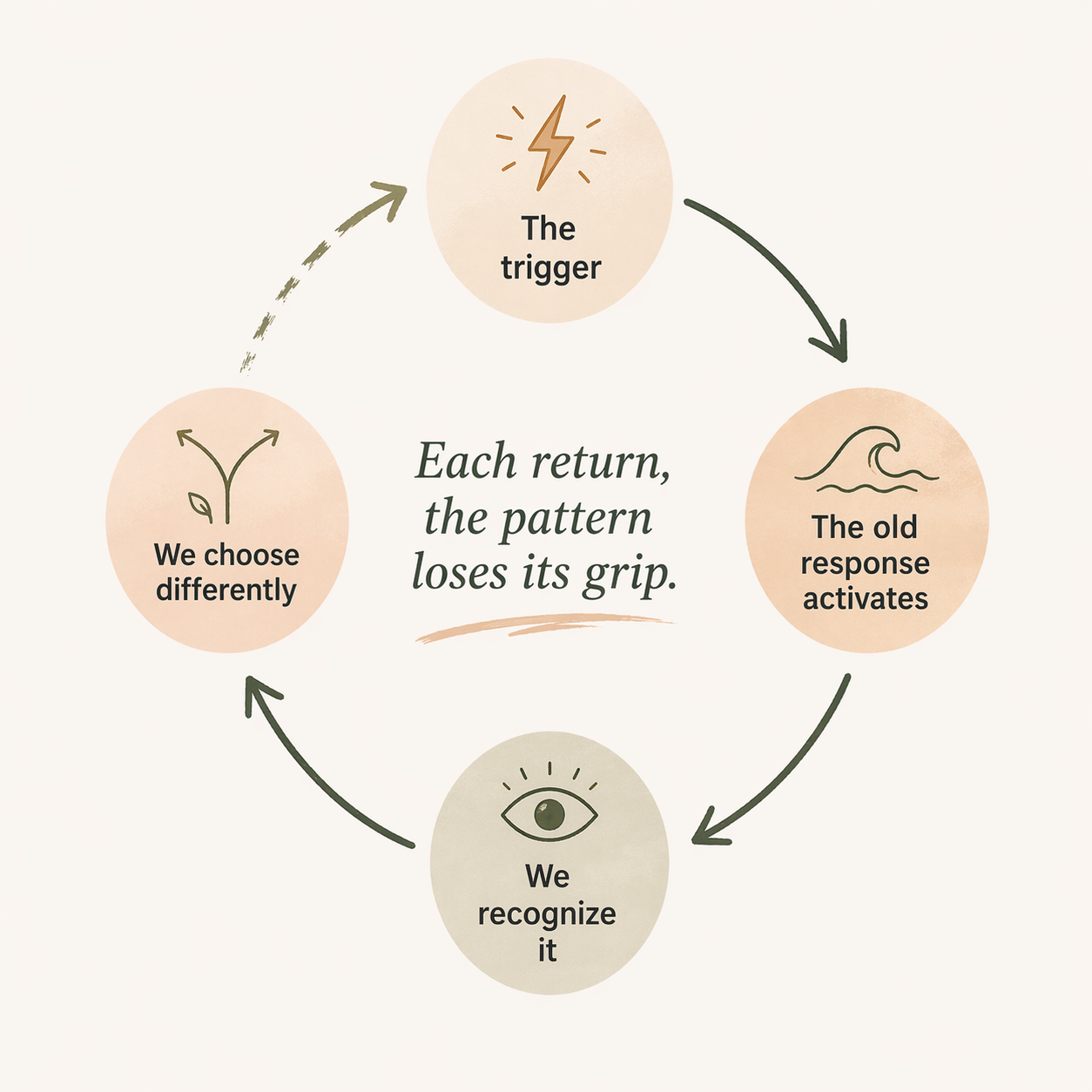
This cycle is the work.
Why does the self-override cycle keep repeating?
This is the part that confuses most people. If you've already worked through self-override, why is it still showing up?
The answer lies in how your nervous system works.
Your nervous system's job is to keep you safe and connected. It learned that overriding yourself = safety. It learned that shrinking = connection.
That learning didn't happen in a single moment. It happened over years. Over many moments where expressing yourself led to rejection or coldness or the message that your truth wasn't welcome.
So when life presents a moment that echoes that original learning, your nervous system activates the old protective response. Your nervous system is doing exactly what it was designed to do.
The amygdala doesn't know the difference between then and now. It recognizes a threat pattern and says: Activate the protective strategy. Override yourself. Keep yourself safe. And you fall back into the old pattern. This is how nervous systems work.
The pattern gets smaller each time
Here's what happens as you move through the cycle repeatedly.
The first time you really recognize self-abandonment, it might take weeks. You're living the pattern for days before you suddenly realize: Oh. I've been abandoning myself.
The second time? It might take a few days to recognize.
The third time? Maybe a few hours.
The fourth time? Immediately after.
Eventually, you recognize it in real time. You're about to override yourself and you catch yourself. You notice the impulse before you act on it.
The pattern doesn't disappear, but your relationship to it changes. You become faster at recognizing it. The grip it has on you loosens. The old response becomes quieter. The choice becomes clearer.
This is the actual work. Not eliminating the pattern, but becoming increasingly aware of it. Increasingly capable of choosing differently when it shows up.
What does real integration actually look like?
A lot of people expect integration to look like: I did the work and now I never feel the old pattern again. That's not how it works. Real integration looks like: I recognize the old pattern. I understand why it's showing up. And I choose differently.
And then: The pattern shows up again. And I recognize it faster. And I choose differently again.
This is the cyclical nature of transformation. It's not linear. It's not a straight line from broken to healed. It's a spiral. You touch the same themes over and over. But each time, you're touching them from a higher place. A more aware place. A more grounded place.
How life brings you back to the cycle
Self-override shows up in predictable moments.
Moments when:
You're tired and someone asks something of you
You're with someone whose approval you still seek
Your boundaries are being tested
You're afraid of disappointing someone
Someone else's needs seem bigger than your own
You're in a situation that echoes the original wound
Your nervous system recognizes these moments as potential threats, and it activates the old protective strategy.
Use this as information. When you notice yourself falling into the old pattern, it's because life has brought you exactly the situation you need to practice choosing yourself—again and gain.
The four movements in action
Let's look at what the cycle actually looks like when it's happening.
Movement 1: The trigger
You've had a full day. You're tired. You've given a lot. Your nervous system is depleted.
Someone you care about asks you to do something. Come to an event. Stay late. Help with a project.
Your immediate internal response is: I don't have capacity for this right now.
But your nervous system remembers: If I say no, they'll be disappointed. If I disappoint them, they might pull away. If they pull away, I'm alone.
The trigger is activated.
Movement 2: The old response
Your mind starts justifying why you should say yes. It's important to them. They've done so much for me. It's only a few more hours. I can handle it.
You override your initial no. You say yes.
You've abandoned yourself. The old pattern is in motion.
Movement 3: The recognition
As you're doing the thing you said yes to—maybe hours later, maybe the next day—you notice something.
You're tired. You're resentful. You're holding tension in your body. You feel disconnected from yourself.
And then it hits: I didn't want to do this. I overrode myself.
You recognize the pattern.
Movement 4: The choice
Now you have a choice. You can beat yourself up for overriding yourself. You can tell yourself you should have known better. You can spiral into shame.
Or you can recognize the pattern and choose differently next time.
In this moment, you might:
Acknowledge that you're here now, and that's okay
Set a boundary for the future
Notice what your nervous system needed (rest) and honor that next time
Understand why the override happened (fear of disappointment)
You've moved through the cycle. You've integrated something. You've learned.
Then life will bring another similar moment. You'll recognize it faster. And the choice will be easier.
Why understanding the cycle changes everything
A lot of people experience self-override as random failure. I did the work and now I'm failing at it again.
But understanding the cycle reframes it completely. You're not failing. You're in the work. You're exactly where transformation happens.
Each time you move through the cycle, you're:
Teaching your nervous system that you're worthy of honoring
Building your capacity to recognize the pattern
Strengthening your ability to choose yourself
Creating new neural pathways that eventually become automatic
This is how nervous systems change. Not through force. Not through willpower. It’s done through repeated, embodied experience.
Each cycle is a victory even though it might not feel like it.
What does the nervous system have to do with it?
Moving through the cycle faster requires nervous system work, not just mental work.
When you recognize the old pattern and your nervous system is already activated, you can't think your way out. Your nervous system is in protective mode. Your prefrontal cortex (the thinking part) is offline.
You need to calm your nervous system first.
This is where breathwork, grounding, and somatic practices come in. They're not extras. They're central to moving through the cycle.
When you slow your breath and ground yourself in your body, you activate your parasympathetic nervous system. You tell your body: We’re safe. The threat has passed.
From that regulated place, you can access the recognition and make the choice.
Over time, your nervous system becomes faster at self-regulating. The cycle moves quicker. The pattern has less grip.
What long-term integration looks like
After moving through the cycle many times, something shifts.
You don't eliminate the pattern, but you change your relationship to it.
Early stage: You notice the pattern days or weeks after it happened.
Middle stage: You notice it in real time, as it's happening.
Later stage: You notice the impulse before you act on it. You catch yourself about to override and you pause. You reconnect with yourself. And you choose differently.
Deep integration: The pattern doesn't activate as strongly. Your nervous system has gradually learned that you're safe being yourself. The trigger still exists, but the threat response is quieter because your nervous system has been retrained through repeated experience.
The most important part
Here's what matters most: the cycle is not a failure. It's the pathway.
You don't transcend self-override and move into some elevated state where you never feel the old pattern again. Instead, you move into a state where you recognize it faster. Where you understand it. Where you choose differently. Where your nervous system gradually learns to trust that you're safe.
When the old pattern shows up again (because it will) you're not devastated. You're not ashamed. You recognize it, understand it, and you choose again.
This is the lifelong work of self-loyalty. Not becoming perfect, but becoming increasingly aware. Increasingly capable. Increasingly grounded in yourself.
How do I move through the cycle with compassion?
When you find yourself in the old pattern again, this is what matters:
Notice without judgment. Don't tell yourself you failed. Tell yourself: I'm in the cycle. This is where the work happens.
Understand the source. Your nervous system activated the old protective response. This makes sense. Your nervous system was trying to keep you safe.
Regulate your nervous system. Before you try to think your way out, slow your breath. Ground yourself. Tell your body it's safe.
Recognize the pattern. See it. Name it. I'm overriding myself. I'm choosing their comfort over my own knowing.
Make a conscious choice. From that regulated, aware place, choose differently. You can see the pattern and you choose to honor yourself instead.
Integrate and learn.What did I learn? What does my nervous system need next time? How will I choose differently?
Then wait for the next cycle. Because it will come. And you'll be more ready.
The grace in the cycle
This cyclical nature is grace. It means you don't have to be perfect. You don't have to fix yourself once and be done. You get to practice. Again and again. Each cycle makes you stronger. Each recognition makes you more aware. Each choice makes you more grounded in yourself.
The cycle is the design of how nervous systems heal.
Every time you move through it consciously, you're teaching your nervous system something new: We're safe being ourselves. We're allowed to honor our own knowing. We're worthy of our own loyalty.
That's the real work.
Not perfection. But presence. Not elimination. But integration. Not transcendence. But recognition and choice, again and again.
Frequently asked questions
Is it normal for self-override patterns to keep coming back?
Yes. Self-override is stored in the nervous system, not just in thought. Even after we understand a pattern intellectually, the body continues activating the old protective response when a similar trigger arrives. That's not regression. That's how nervous systems work. The goal isn't to stop the cycle from starting. It's to move through it faster and with more awareness each time.
What's the difference between recognizing a pattern and actually changing it?
Recognition is the beginning, not the end. We can see a pattern clearly and still fall back into it because the nervous system hasn't caught up yet. Real change happens through repeated embodied experience—recognizing the pattern, regulating the nervous system, and choosing differently over and over. Each repetition rewires the response at a deeper level than insight alone can reach.
How do I know if I'm making progress if the pattern keeps showing up?
The measure of progress is how quickly we recognize it and how much grip it has. Early on, we might notice the override days later. Over time, we catch it in the moment. Eventually, we notice the impulse before we act on it. That shortening window is the evidence of real change, even when it doesn't feel like it.